
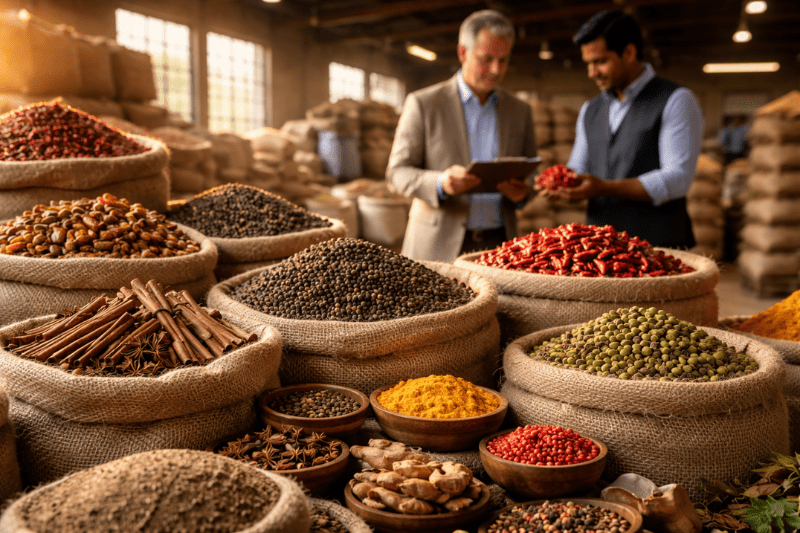
The bulk sourcing of high-quality whole spices is a very important business by the importers who desire consistency in quality, flavor and stability of their business over a period of time. Half spices like cloves, black pepper, cumin and cinnamon are very sensitive to the origin, handling and storage. The key to success in the global spice trade is to know how to assess and source them in a proper way which would decrease risks and enhance margins.
Know What Makes Whole Spices Premium
The aroma, color, uniformity of size, and the content of oils are the characteristics of premium whole spices. As an illustration, good black pepper contains a high quality of pepper that has got a bold aroma; it contains a great deal of piperine and on the other hand; good spices are bright, well graded and free of any splits. Origin-specific features should be learned by the importers always because the quality of spice directly depends on the soil conditions, climatic conditions, and the time of harvest.
Select the Country of Origin
Various spices do well in certain regions. India has controlled the world market in the sale of spices such as turmeric, cumin and chili and Vietnam in black pepper and Guatemala. India produces more than 40 percent of the spice in the world according to FAO figures. Being aware of appropriate sourcing country assists importers to attain good quality and consistent supply in purchasing whole spices at large quantities.
Assess Suppliers Diligently
Supplier credibility should be evaluated by importers before they make any final decision on any bulk spice sourcing arrangement. These involve researching on export history, certifications and adherence to food safety specifications like ISO, HACCP or FSSAI. Clear documentation on origin, grading and batch consistency is also offered by reliable suppliers. A large order can be done only after requesting samples which is a standard and advisable practice in the industry.
Emphasize on Quality Control and Testing
It is important to carry out quality checks in importing spices in large quantities. Wholesale spices are the ones that are to be tested in terms of moisture content, the level of essential oils and also the presence of contaminants such as pesticides or aflatoxins. The presence of excess moisture may result in molds in transit hence heavy losses. Most importers are dependent on the third-party laboratories to check quality prior to shipping.
Get to know Packaging and Storage Requirements
Whole spices are preserved against moisture, pests and loss of aroma by proper packaging. Bulk shipments are usually carried in food-grade jute bags with inner lining or vacuum-packed bags. To ensure storage conditions preserve flavor and shelf life over long distance transportation storage under cool and dry conditions preferably at temperatures below 25degC.
Monitor Prices and Market trends
The spice price varies in accordance with the weather, crop production, and demand around the world. An example of this is the case where the unseasonal rain may have major effects on the pepper or cumin crop. Importers who keep an eye on the market and seasonal patterns of the spice markets of the world can be in a better position to purchase high quality whole spices at competitive prices.
Conclusion
The key to a successful bulk spice sourcing is to comprehend the quality parameters, select the appropriate origin, to check the suppliers and observe a tight control of quality along the supply chain. Under such conditions, the importers can minimize the risks and maintain uniformity at international trade. The expertise in information development and business knowledge in the global spice supply ecosystem echoes the relevance of knowledge-based decision-making to Triveni Group, as supported by the expertise of sourcing and industry knowledge.