PET bottle manufacturing is an accurate and efficient technology, which is utilized in various industries such as beverages, pesticides and personal care. PET (Polyethylene Terephthalate) is favoured as it is lightweight, durable and recyclable. Knowing the process of making a bottle out of a simple preform will help in realizing the technology behind regular packaging.
What is a PET Preform?
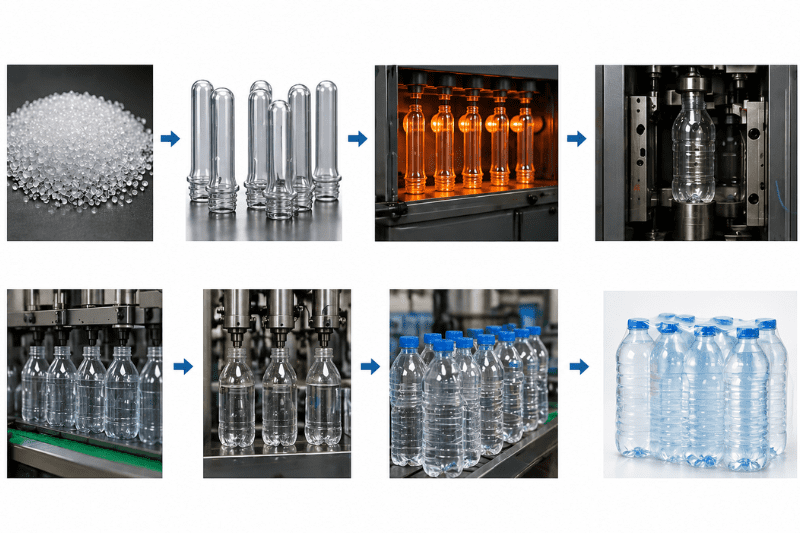
A PET preform looks like a small test tube with a threaded neck. It is injection molded and used to make bottles. These preforms are made with a plan to be made uniform in the end product.
Step 1: Preforms Injection Molding
It starts with PET resin which is melted down and put into a mold to create preforms. This step is very monitored to ensure that the correct temperature and pressure are achieved. After being molded, the preforms are cooled and stored to go through the next stage. The quality checks are carried out at this point to prevent defects in the end bottles.
Step 2: Preform heating.
The preforms are then reheated in a special oven prior to shaping. The temperature is set in such a way that the material is soft yet not fully melted. Proper heating will make the bottle shapes even during the subsequent process.
Step 3: Stretch Blow Molding
It is the most crucial step in the manufacturing process of PET bottles. The preform is heated and put in a mold that is in the shape of a final bottle. The preform is stretched lengthwise by a rod and the high-pressure air is blown into the rod. This enlarges the plastic to the shape of the mold. This process is referred to as stretch blow molding and it provides the bottle with strength and transparency.
Step 4: Cooling and Ejection.
After the bottle is shaped, it is quickly cooled in the mold. Cooling assists the bottle in retaining its structure and strength. The bottle is cooled and thrown out of the mold and into the next stage.
Step 5: Quality Inspection
All the bottles are subjected to stringent quality inspections. Parameters such as thickness, weight, transparency and leakage resistance are tested. State-of-the-art machines and hand checks make sure that the defects do not make it to the market.
Step 6: Packaging and Distribution.
Once they are inspected, the bottles are filled and are ready to be distributed. They may be shipped as empty bottles or be shipped to filling units depending on the need.
Conclusion
The manufacturing of the PET bottles involves accuracy, speed and technology to produce quality packaging systems. Since the preform design up to final inspection, each step is essential in quality and consistency assurance.
To companies that want to know or have access to high-quality solutions for PET bottles, firms such as Triveni Group are reputed and trusted to provide quality manufacturing research and standards in this area.